

Why Standard Paint Fails in Commercial Spaces
Facility managers across Central Texas repaint busy corridors every two to three years because standard wall paint simply cannot handle daily abuse. Rolling carts, backpacks, chair impacts, and cleaning chemicals wear through builder-grade latex fast.
Specifying the right coating from the start is the most cost-effective decision you can make for any commercial painting project. Upgrading to a durable product adds a modest amount to the initial material cost but can double or triple the time between repaints.
Three Tiers of Commercial Durability
The terms “scrubbable” and “scuff-resistant” describe different chemical properties, and understanding the distinction matters when comparing products.
Standard commercial latex works well in low-traffic offices, conference rooms, and private suites. It costs the least per gallon but marks easily and wears through under repeated cleaning.
Scrubbable paint is formulated to withstand aggressive washing without losing film integrity. Industry testing measures this with the ASTM D2486 scrub test, which counts how many abrasive cycles the film survives. Quality scrubbable products handle 2,000 or more cycles. These work well in break rooms, restrooms, and kitchenettes.
Scuff-resistant paint uses modified urethane or ceramic technology to resist marks before they happen. Products like Benjamin Moore Scuff-X prevent shoe scuffs, cart marks, and bag rubs from leaving visible traces. This category delivers the best performance in corridors, lobbies, and retail sales floors.
| Feature | Standard | Scrubbable | Scuff-resistant |
|---|---|---|---|
| Scrub resistance | Low | High (2,000+ cycles) | Moderate to high |
| Resists initial marks | Low | Moderate | Very high |
| VOC levels | Varies | Often higher | Modern options under 30 g/L |
| Best for | Private offices | Restrooms, break rooms | Corridors, lobbies, retail |
Choosing the Right Sheen
Sheen affects both durability and appearance. A higher gloss creates a tighter, less porous surface that resists moisture and physical wear. The tradeoff is that glossier finishes reveal every drywall seam and patch under commercial lighting.
For a full breakdown of the sheen spectrum, see our sheen guide. In commercial applications, three options dominate.
- Eggshell for offices and conference rooms. Offers decent washability with a low-reflectance look that hides wall imperfections.
- Satin for corridors and retail walls. Provides strong durability while still forgiving of drywall texture variations. This is the most popular finish for high-traffic commercial zones.
- Semi-gloss for doors, frames, restrooms, and back-of-house surfaces. Maximum moisture resistance for areas that get wiped with chemical cleaners regularly.
Where to Invest in Premium Products
You do not need scuff-resistant paint on every wall in your building. Strategic allocation puts premium products where they deliver the most value and standard products where abuse is minimal.
Most wall damage in commercial spaces concentrates in a strike zone two to four feet off the floor, exactly where carts, chair backs, and bags make contact. Focus your premium coating budget on these high-impact areas.
Prioritize premium coatings for:
- Main corridors and elevator lobbies
- Reception and waiting areas
- Retail checkout zones and fitting rooms
- Stairwells and handrail zones
- Door frames and outside corners
Standard products work fine for:
- Private offices and conference rooms
- Storage and utility areas
- Above-strike-zone wall sections in corridors
Touch-Up Compatibility
Mismatched touch-ups often look worse than the original scuff. UV exposure and normal environmental conditions cause wall paint to shift color slightly within the first six to twelve months. A fresh dab of the original paint will stand out against the aged surface.
Preventing this problem requires good record-keeping and proper technique.
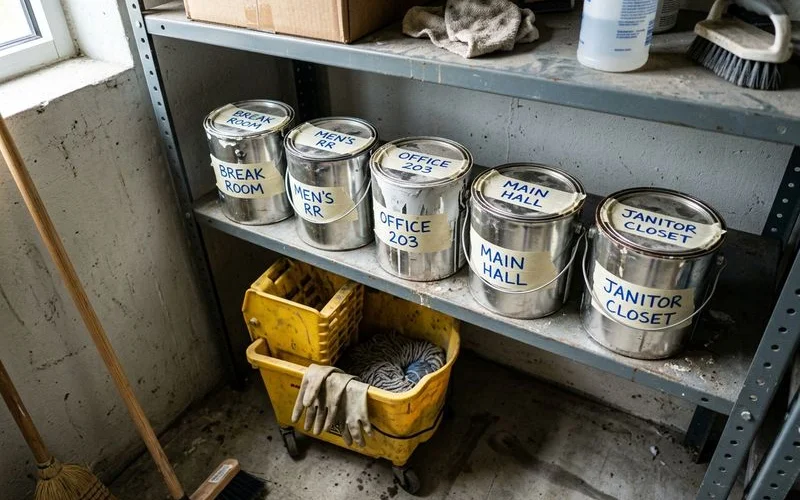
- Store the exact manufacturer name, product line, color code, and sheen in a digital maintenance record.
- Keep labeled leftover paint in a climate-controlled location.
- When touching up, paint from corner to corner on a wall section rather than dabbing individual spots.
Limestone & Lacquer leaves a documented touch-up kit and a detailed product list with every commercial project. This makes future maintenance straightforward for your janitorial team.
Lifecycle Cost Comparison
The cheapest gallon is rarely the cheapest choice over time. A corridor painted with standard latex needs a full repaint every two to four years. The same corridor in a scuff-resistant product holds up five to eight years between repaints.
| Cost factor | Standard commercial | Scuff-resistant |
|---|---|---|
| Material cost | Lower upfront | Slightly higher upfront |
| Repaint frequency | Every 2 to 4 years | Every 5 to 8 years |
| Maintenance disruption | High frequency | Low frequency |
| 10-year total cost | Higher | Lower |
For a full breakdown of what drives commercial project pricing, see our guide on how much commercial painting costs in Texas.
Protecting Vulnerable Corners and Trim
Paint handles a lot of daily wear, but physical barriers extend the life of your most vulnerable surfaces. Our teams frequently recommend combining premium coatings with targeted protection.
- Hard enamel on door frames and doors in semi-gloss for maximum impact resistance
- Polycarbonate corner guards at outside corners in heavy-traffic zones
- Stainless steel kick plates on high-use entry doors
- Chair rails in conference rooms and break areas
These additions cost relatively little but significantly extend the full maintenance cycle of the surrounding paint.
Color Strategy for Busy Spaces
The shade you choose directly affects how quickly a wall looks dirty between cleanings. Very light whites (Light Reflectance Value above 80) highlight every shadow and smudge. Very dark colors show dust and clear scratches like a magnifying glass.
Mid-tone neutrals with an LRV between 40 and 60 hide everyday marks best. Warm grays and soft taupes are the most popular choices for Georgetown commercial properties. Bold brand accent colors work well on feature walls positioned away from the heaviest traffic paths.
Cleaning Guidelines for Your Maintenance Team
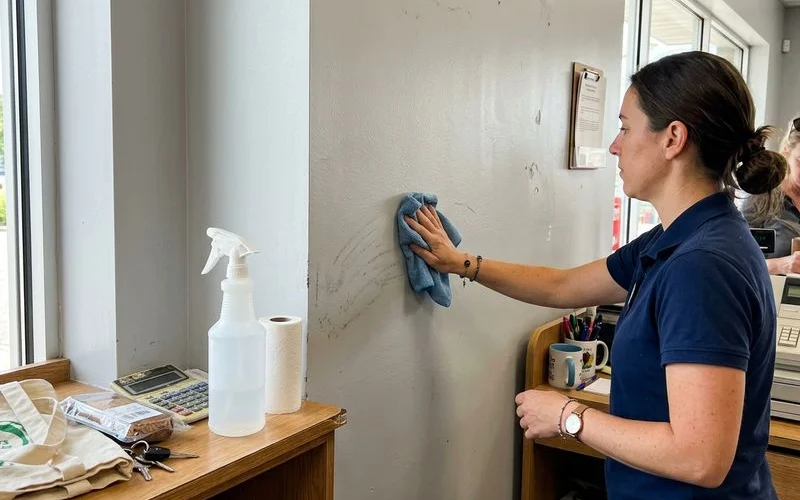
Even the toughest commercial coating can be damaged by the wrong cleaning technique. Ban abrasive melamine sponges from painted walls. They act like ultra-fine sandpaper and permanently dull the sheen.
Provide your janitorial staff with these simple rules. Use a soft microfiber cloth, not abrasive pads. Start with plain water before upgrading to mild soap. Stick to pH-neutral cleaners. Wipe gently and avoid harsh solvents or heavy degreasers.
Planning Your Next Project
Every commercial painting project starts with a site walk to assess your specific traffic patterns, lighting conditions, and maintenance routines. You receive product recommendations mapped by area, ensuring premium coatings go where they deliver the most value and standard products cover the rest.
Contact Limestone & Lacquer to schedule your facility walkthrough.