
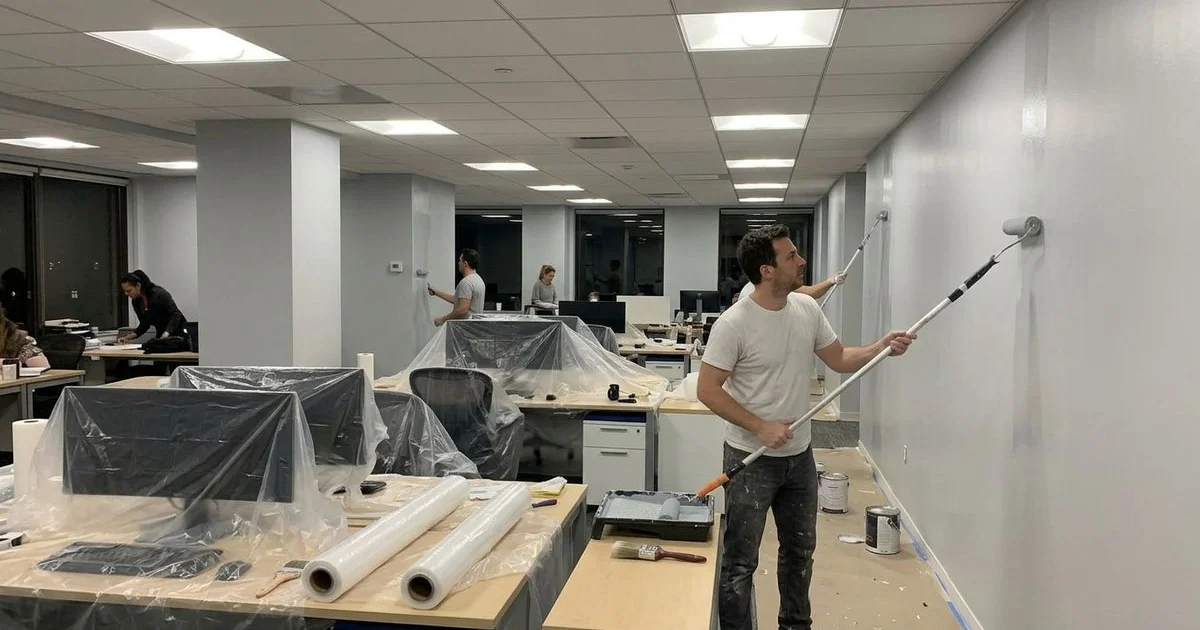
Why Overnight Scheduling Matters
Closing a business for interior painting is rarely practical. Lost revenue, disrupted client meetings, and displaced employees make daytime work a poor option for most commercial properties. Limestone & Lacquer Painting Co. runs dedicated overnight crews specifically to eliminate that problem.
Our commercial painting teams arrive after your last employee leaves and finish before the first one returns. Every project follows a strict sequence of protection, painting, and reset that keeps your operations running without a single lost business day.
Planning the Shift Window
The overnight window typically spans eight to ten hours, depending on your building’s closing and opening times. Our project manager meets with your facility contact to map out an exact schedule before the first shift begins.
A standard office closing at 6:00 PM and opening at 7:00 AM gives the crew roughly 11 usable hours after setup and before the morning reset. Retail spaces with later closing times compress the window, so those jobs may need additional nights. We build a phased plan that divides the space into zones, finishing one complete section per shift rather than leaving partially painted walls visible to clients.
Key scheduling details we confirm during the pre-job walkthrough include security alarm codes and after-hours access procedures, HVAC settings and whether the system runs overnight, elevator reservations for moving equipment to upper floors, and any restricted areas or server rooms that require special clearance.
Protecting Your Space
Everything in the work zone gets covered or moved before a single roller touches the wall. Our crews follow a checklist that prioritizes electronics, flooring, and client-facing fixtures.
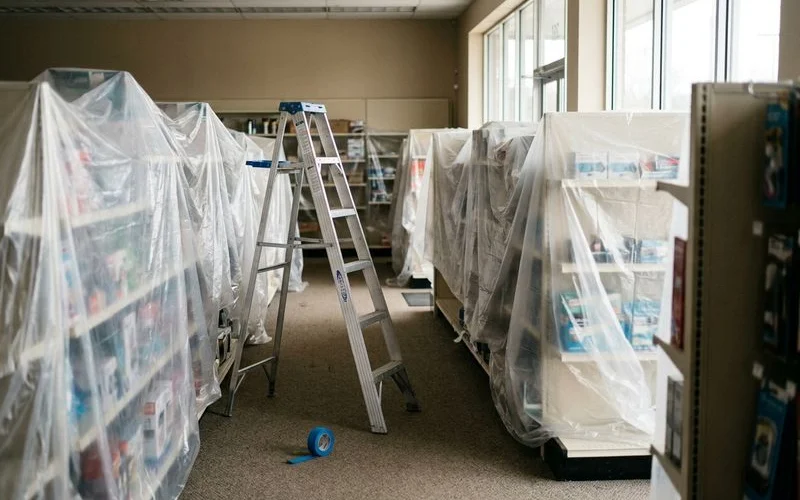
Workstations receive individual wraps of anti-static plastic sheeting. Monitors, keyboards, and phone systems are sealed rather than simply draped. Printers and copiers get wrapped with heavy-duty 3M Hand-Masker film and taped at every seam. Server closets and network racks remain locked and untouched unless your IT team clears them in advance.
Floors are covered with canvas drop cloths, not thin plastic that tears under ladders. Common areas like break rooms and lobbies receive extra protection because foot traffic from the crew concentrates there during transport.
The Painting Phase
Once protection is complete, the crew works top to bottom: ceilings first, then walls, then trim and accent surfaces. Two-person teams leapfrog across the zone so one section is drying while the next receives its coat.
We use premium zero-VOC commercial products like Benjamin Moore Scuff-X or Sherwin-Williams ProMar 200 Zero VOC. These fast-drying formulas reach touch-dry status within 60 to 90 minutes, which allows second coats on the same shift. The low odor profile is critical for spaces where employees return just hours after application.
Georgetown’s humid subtropical climate means interior humidity control matters even at night. Our crews verify that the building HVAC is running and that indoor relative humidity stays below 50 percent during application. High moisture levels slow cure times and can leave the surface tacky by morning.
The Morning Reset Protocol
The reset is the phase that separates professional overnight work from amateur efforts. Our crew lead runs a full reversal checklist starting 90 minutes before your staff’s arrival time.
Protection comes down in reverse order: floor coverings first, then furniture wraps, then workstation plastics. Every chair, desk, and monitor goes back to its original position. The crew lead photographs each zone before and after to confirm nothing shifted.
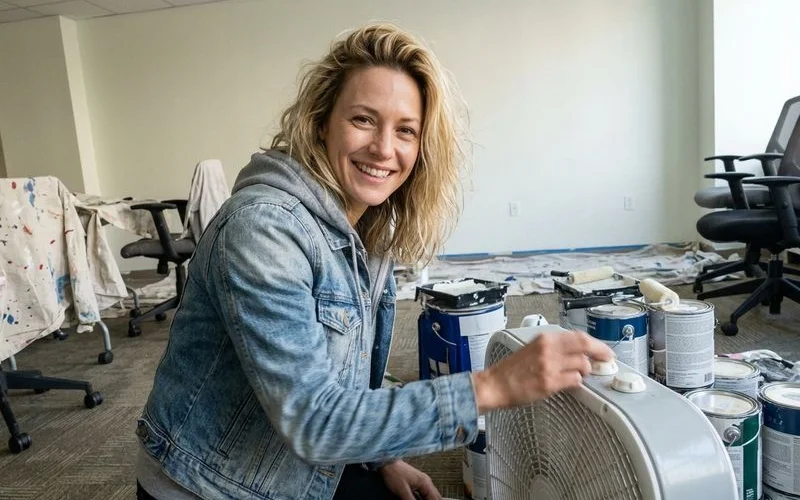
Industrial fans run continuously from the moment painting finishes until the crew departs. Windows that can open get cracked for cross-ventilation. The goal is a space that looks, smells, and functions exactly as it did the evening before, except with fresh walls.
Phasing a Multi-Night Project
Large offices and retail floors rarely finish in a single overnight session. A 5,000-square-foot open-plan office typically needs three to four nights. We phase the work so that completed zones are fully usable the next business day while adjacent zones are scheduled for the following night.
Phasing priorities follow a logical order. Reception areas and client-facing spaces go first because they carry the highest visibility. Break rooms and back offices go last because temporary disruption there has the lowest impact. Hallways and corridors get painted in sections, keeping at least one clear path at all times.
Common Challenges and How We Handle Them
Noise restrictions. Some Georgetown office parks and mixed-use buildings enforce noise ordinances after 10:00 PM. We use HVLP sprayers and foam rollers that stay well below typical decibel limits. No compressors or heavy sanding equipment runs after quiet hours begin.
Elevator access. Multi-story buildings require elevator holds to move ladders, paint, and drop cloths efficiently. We coordinate hold times with building management to avoid conflicts with janitorial crews working the same hours.
Security protocols. Our crew members carry photo identification and sign in with building security at the start of every shift. We provide a complete roster to your property manager before the project begins.
Wet paint exposure. Accent walls or deep color changes that need extra dry time get a “wet paint” barrier and signage placed during the morning reset. This precaution prevents accidental contact during the first few business hours.
Specialized Spaces
Restaurants, medical offices, and retail stores each carry unique overnight requirements. Restaurant kitchens demand food-safe masking and heavy degreasing before any primer goes on. Medical exam rooms need full containment and HEPA filtration to meet infection control standards. Retail environments require careful protection of merchandise displays and point-of-sale systems.
Our detailed guide on restaurant painting covers the food-service-specific protocols for coatings, odor management, and health code compliance.
What a Typical Timeline Looks Like
| Space type | Average nights needed | Shift hours |
|---|---|---|
| Small office (under 2,000 sq ft) | 1 to 2 | 7 PM to 5 AM |
| Mid-size office (2,000 to 5,000 sq ft) | 3 to 4 | 6 PM to 5 AM |
| Retail floor (3,000 to 8,000 sq ft) | 3 to 5 | After close to before open |
| Medical clinic | 2 to 4 | After last patient to 6 AM |
These estimates assume standard wall-and-ceiling scope with moderate prep. Heavy drywall repairs, accent walls, or full trim repaints add one to two nights depending on scale.
Starting Your Overnight Project
The first step is always a daytime site walk. Our estimator visits your space during business hours to measure surfaces, note protection requirements, and discuss scheduling constraints with your facilities team. You receive a fixed written quote that includes every shift, every product, and the exact reset protocol.
Contact Limestone & Lacquer to schedule your walkthrough and get your project on the calendar.