
Timing Determines Whether the Stain Lasts
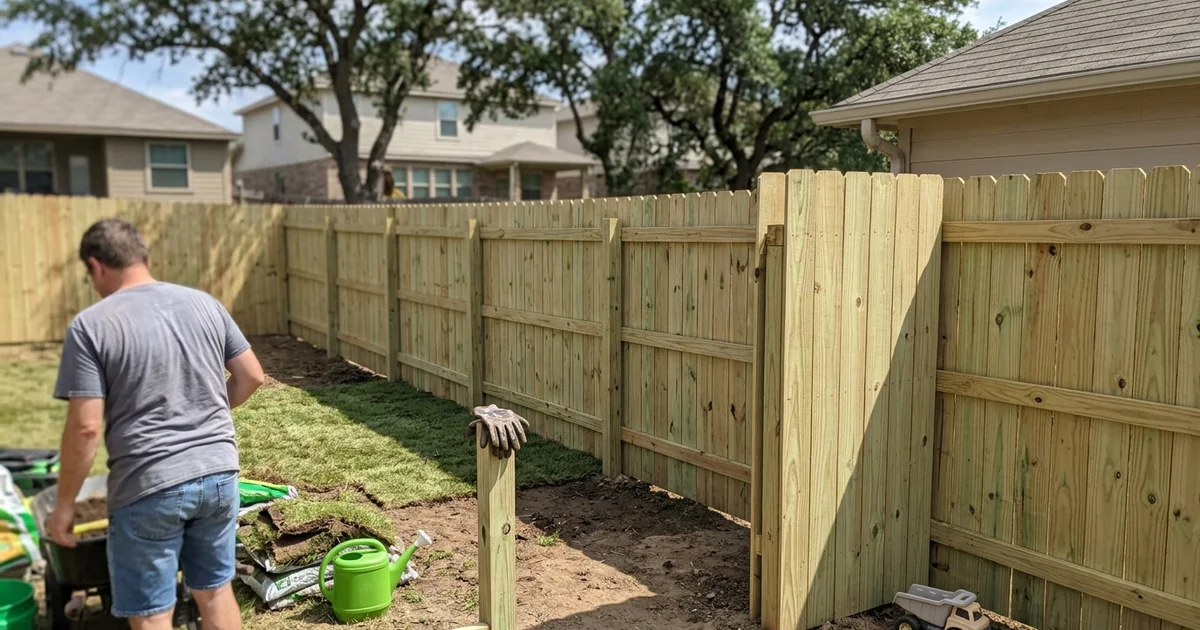
A brand-new fence or deck represents a significant investment. The timing of the first stain application determines whether that investment is protected for years or wasted within months. Unstained wood in the brutal Central Texas climate can deteriorate structurally within seven to ten years, while a properly maintained structure lasts 15 to 20 years.
This guide answers the primary question of how long to wait to stain new fence projects and explains why moisture content, not the calendar, controls the schedule for fence staining in Georgetown.
Why Moisture Content Is the Deciding Factor
Water is the biggest enemy of a fresh stain application. The internal moisture content of the lumber must drop below 15 percent before any coating goes on. Major manufacturers like Armstrong-Clark and Wood Defender set this threshold in their product specifications.
When wood is too wet, water molecules block the internal cellular channels that the stain needs to penetrate. Finish applied to saturated boards pools on the surface instead of soaking in, then peels off in sheets once the sun heats the wood.
New lumber arrives with varying moisture levels depending on species and treatment:
- Pressure-treated pine is saturated with modern copper-based preservatives like Copper Azole, making it extremely wet at delivery
- Cedar ships drier from the mill but can absorb significant moisture during yard storage and installation
Measure, Do Not Guess
Relying on calendar-based rules produces unreliable results. A Georgetown summer pulls moisture out rapidly, while a rainy spring keeps boards saturated well past typical timelines.
Professional pin-type moisture meters measure electrical resistance between two probes and provide exact depth readings. Pinless electromagnetic meters avoid poking holes in new lumber while still giving reliable surface readings.
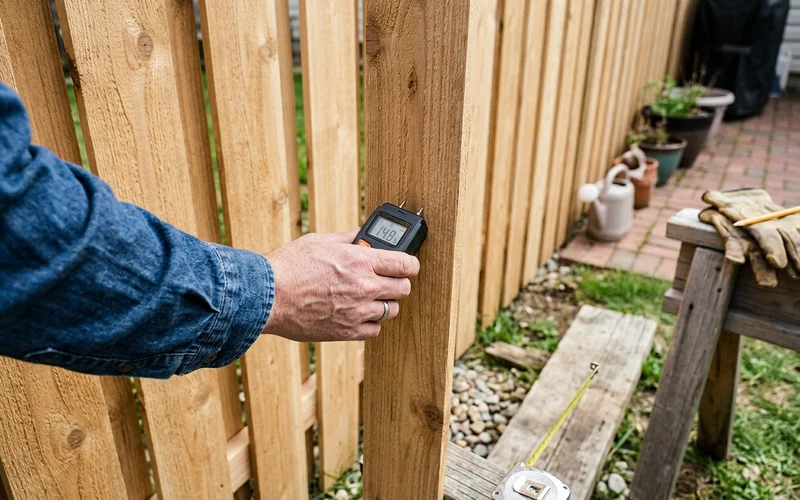
A simple water bead test offers a backup method. Sprinkle water on a dry-looking board. If it absorbs within minutes, the pores are open and the wood is ready. If the water beads on the surface, more drying time is needed.
Cedar vs Pressure-Treated Pine
These two common lumber species behave entirely differently during the curing phase.
| Feature | Cedar | Pressure-treated pine |
|---|---|---|
| Moisture target | Under 15 percent | Under 15 percent |
| Typical wait time | 2 to 4 weeks | 3 to 6 months |
| Natural color | Warm red to tan | Greenish or tan from treatment |
| Special concern | Tannin bleed | Slow drying, mill glaze |
| Stain choice | Semi-transparent to show grain | Semi-transparent or solid |
Cedar typically reaches the 15-percent threshold within a few weeks under direct Central Texas sunlight. Pressure-treated pine requires significantly longer because the copper-based preservatives must evaporate from the deep cellular structure.
Tannin Bleed in Cedar
Cedar contains naturally high levels of tannic acid, which provides excellent rot resistance. These water-soluble tannins migrate to the surface when the wood gets wet, leaving dark, tea-colored streaks that discolor light-toned finishes.
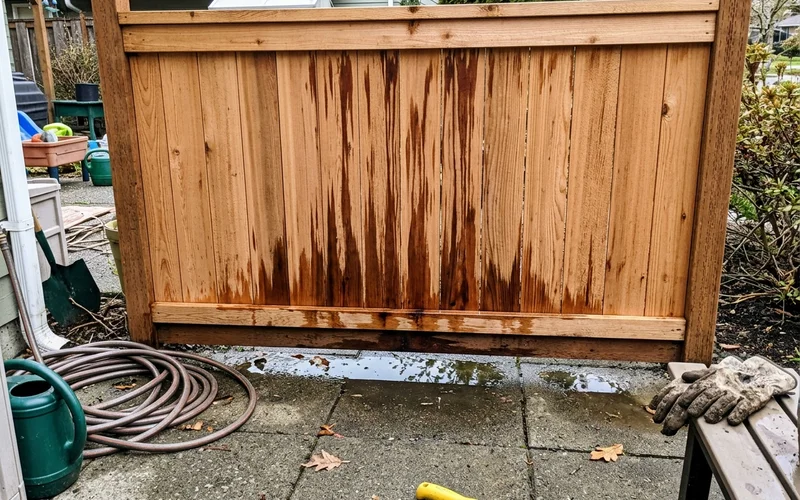
Proper chemical preparation eliminates the problem. An oxalic acid-based wood brightener neutralizes surface tannins and restores the natural blonde or red hue before staining. Steps to minimize tannin bleed:
- Clean the surface with an oxalic acid brightener
- Allow a full 48 hours of drying time
- Select a penetrating new cedar fence stain matched to the species
- Consider a slightly deeper tint to mask any future tannin migration
Mill Glaze on Fresh Lumber
New boards often arrive with a deceptively smooth, shiny surface. During manufacturing, high-speed planers generate friction that draws natural resins to the surface. Once cooled, these resins harden into a glossy crust that completely blocks stain absorption.
A chemical wood cleaner and light sanding with 120-grit paper break through this barrier and open the pores for full penetration.
Staining Too Early
Applying stain to lumber that has not reached the 15-percent moisture threshold produces predictable failures:
- Zero penetration into the wood fibers
- Splotchy, uneven pigment distribution across the surface
- Immediate peeling or flaking from hydrostatic pressure as trapped moisture tries to escape
- Wasted material and labor costs
Repair calls spike every spring from property owners who tried to seal wet lumber during the previous fall.
Waiting Too Long
Delaying the first application carries its own set of structural risks. Central Texas UV begins breaking down lignin, the natural polymer binding wood fibers together, immediately upon exposure.
Beautiful new installations turn a brittle, silvery gray within weeks. The fibers dry out rapidly, leading to:
- Deep surface checking and cracking
- Severe warping or cupping on horizontal boards
- Splitting around nails and fasteners
- Increased need for aggressive chemical stripping before staining can proceed
The sweet spot arrives faster in Georgetown’s intense sun than in cooler northern climates. Moisture meter readings, not calendar dates, determine the right moment.
Decks Need Faster Attention
Horizontal deck floors absorb unshaded direct sunlight all day and hold standing water after every rainstorm. These harsh conditions accelerate lignin breakdown and graying faster than vertical fence panels.
Test deck moisture levels weekly after construction. Apply a penetrating oil the same week the boards drop below 15 percent to prevent surface checking.
Pre-Stained Lumber
Factory-dipped panels look appealing at the lumber yard, but the initial coating is typically a low-solids tint measuring barely one to two mils thick. This ultra-thin barrier provides minimal UV resistance.
Plan for a full application of a high-quality penetrating product within the first 12 months to deliver the deep conditioning the wood actually needs.
Common Questions From New Homeowners
My builder says to wait a full year. Is that right? Old guidelines were based on CCA-treated wood from before 2004, which dried extremely slowly. Modern ACQ pine and natural cedar are usually ready in a fraction of that time. The 15-percent moisture rule is always more accurate than an arbitrary calendar date.
Will staining void my fence warranty? A quality finish rarely voids a warranty and usually extends the structure’s lifespan. Check the specific terms from your installation contractor.
Should both sides be stained? Yes. If one side remains bare, it weathers at a different rate. The uneven moisture absorption creates tension in the wood fibers that causes warping.
Professional Moisture Assessment
Limestone & Lacquer Painting Co. visits your property, checks internal moisture with professional meters, and gives you a precise readiness date. Once the lumber reaches the sub-15-percent threshold, we remove mill glaze, apply a commercial-grade brightener, and back-brush a premium UV-protective coating deep into the grain. Our guide on re-stain intervals explains how to maintain your investment for the next decade.