

The Mixed-Material Challenge
Many Georgetown homes combine natural limestone or brick facades with painted siding and trim. Homeowners frequently debate whether to paint or limewash limestone brick to achieve a more cohesive or modern exterior look.
Our general recommendation is painting around limestone rather than coating the stone directly. That approach avoids locking yourself into indefinite masonry repainting. The right choice depends on your specific goals, the condition of the masonry, and how much ongoing maintenance you are willing to accept.
Option 1: Leave the Stone Natural
Natural limestone and brick need almost no maintenance over their lifespan. They do not peel, barely fade, and never require recoating. Leaving the masonry bare saves the average $4 to $8 per square foot cost of exterior brick painting and keeps the facade performing exactly as the builder intended.
Pros
- Zero ongoing paint maintenance on the stone
- Masonry breathes freely as designed
- Retains regional character that many buyers value
- All future decisions remain fully reversible
Cons
- The existing stone color limits your secondary palette
- Certain older brick tones can be difficult to modernize without coating
Color consultants work around the stone’s natural undertones by adjusting body and trim colors. Our guide on pairing colors with stone walks through the exact process.
Option 2: Limewash
Limewash produces a soft, chalky finish that bonds chemically with porous brick through a process called carbonation. The mixture soaks into the masonry and becomes part of the stone rather than sitting on top as a film.
Quality products like Romabio Classico Limewash carry a vapor permeability rating below 0.01 meters, offering exceptional breathability.
Pros
- Outstanding moisture permeability
- Creates a mottled patina that ages gracefully
- Erodes gradually over 5 to 7 years rather than peeling
- Material costs are generally lower than premium paint
Cons
- Requires a maintenance refresh coat every few years
- Results depend on the original masonry’s porosity
- Dense or heavily sealed stone does not absorb lime properly
Limestone & Lacquer Painting Co. does not offer limewash application. This technique is worth considering, and local specialists handle the application if you choose this route.
Option 3: Paint
Painting masonry delivers the most dramatic color transformation. A solid coat covers outdated tones entirely and unifies mismatched additions. In many Georgetown neighborhoods, exterior changes need committee sign-off first, so check how HOA exterior paint color approval works before committing.
The correct product is a breathable mineral silicate paint or a breathable elastomeric masonry coating like Sherwin-Williams Loxon. Standard acrylic house paint acts like a plastic film on porous limestone, trapping humidity and leading to bubbling and spalling.
Pros
- Complete, uniform color transformation
- Modernizes outdated or visually busy brick patterns instantly
- Unifies mismatched masonry from different building phases
Cons
- Stripping paint from textured stone is extremely slow and expensive
- Creates a surface that requires repainting indefinitely
- Wrong product choice traps moisture and causes spalling
- Peeling sections on rough masonry are very difficult to patch
Moisture and Breathability
Masonry relies on natural vapor exchange to stay intact. Water vapor constantly migrates through porous materials like brick and mortar. Sealing these surfaces with a heavy, non-breathable acrylic creates three distinct problems.
- Spalling: The face of the brick pops off when trapped moisture freezes or expands
- Bubbling paint: Vapor pressure behind the film lifts the coating
- Hidden mold: Growth develops within mortar joints where moisture cannot escape
True masonry paints feature microporous crystalline structures that let vapor flow outward while blocking wind-driven rain from soaking inward. Williamson County’s humid subtropical climate makes product selection especially critical.
Efflorescence: The White Warning
White powdery deposits near the foundation or below poorly maintained gutters signal efflorescence. Water travels through the brick, dissolves natural mineral salts, and leaves them on the surface as it evaporates.

Coating over efflorescence without addressing the water source guarantees a failed paint job. The salts continue migrating and eventually push the primer off the wall. Fixing sprinkler head positioning and foundation grading solves the underlying cause.
Side-by-Side Comparison
| Feature | Leave natural | Limewash | Paint |
|---|---|---|---|
| Look | Original stone or brick | Soft, matte, mottled | Solid, uniform color |
| Breathability (Sd Value) | Full (< 0.01m) | High (< 0.01m) | Varies (0.1m - 0.3m typical) |
| Maintenance | Minimal | Refresh every 5-7 years | Standard repaint cycle |
| 2026 Cost Estimate | $0 | $3 - $6 per sq ft | $4 - $8 per sq ft |
| Reversible | N/A | Partly, power-washable early | Very difficult |
| Risk | Low | Low to moderate | Moderate if moisture issues |
| Offered by us | Yes, we paint around it | No | Case by case |
The Trim-Only Approach
The most cost-effective upgrade is keeping stone bare while refreshing the surrounding accents. Crisp trim, fresh siding, and clean fascia boards make the entire property look transformed without touching the masonry.
Our painters mask the stone edges carefully before cutting in by hand.
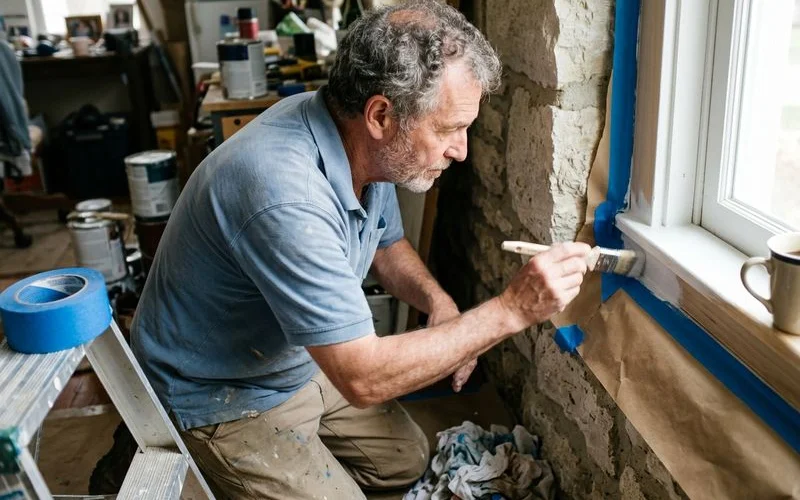
This technique produces a razor-sharp line where painted trim meets rough limestone. Clean edges make an older facade look intentional and high-end.
If You Decide to Paint the Masonry
A successful masonry paint job requires exhaustive surface preparation. Cutting corners leads to peeling within the first 18 months.
- Soft-wash the surface and remove any efflorescence chemically
- Correct active moisture sources and fix drainage issues
- Repair cracked mortar joints to create a sound surface
- Apply a specialized bonding agent like ROMABIO Biogrip Micro Primer
- Finish with two coats of a breathable mineral topcoat
We walk the property with you and discuss the risks honestly. Sometimes the stone is too soft or too moisture-compromised for any coating.
Cleaning Stone Before Painting Around It
Even when the masonry stays natural, cleaning it enhances the finished result. We include a gentle soft wash for all stone sections bordering new trim paint. Low-pressure water and specialized detergents remove dirt and mildew safely. High-pressure washing above 1,000 PSI can blow old mortar out of joints and damage the stone surface.
Clean limestone next to fresh trim makes the entire home look years younger.
Choosing Trim Colors for Stone Facades
The right accent color determines whether your exterior looks cohesive or mismatched.
- Creamy or tan limestone pairs with warm whites like Benjamin Moore Swiss Coffee
- Gray or cool limestone demands cleaner whites or subtle cool-toned slates
- Red or orange brick looks sharp against deep anthracite or dark charcoal trim
- Mixed stone palettes benefit from a mid-tone greige bridging warm and cool elements
Test physical samples against the actual masonry outdoors at different times of day. Our guide on choosing colors in Central Texas covers the full process.
Our Recommendation
Natural stone is one of the strongest architectural features of any Georgetown home. In most situations, leaving it bare and updating the trim is the smartest financial and aesthetic choice. Contact Limestone & Lacquer to schedule a site visit and get a customized exterior plan.