

The Hiring Decision Shapes the Outcome
The Federal Trade Commission logged over 81,000 complaints about home improvement contractors in a single recent year. Most of those frustrations trace back to hiring the wrong crew rather than using the wrong paint. Skipped prep, missing insurance, and surprise charges are almost entirely avoidable when you ask the right questions up front.
This checklist works whether or not you hire Limestone & Lacquer Painting Co.. Print it, save it, and ask every painter the exact same questions. The answers will make the difference between a fair bid and a costly mistake immediately clear.
1. Are You Insured, and Can I See Proof?
Every legitimate contractor carries two specific types of insurance. Verify both policies before anyone sets up a ladder at your property.
- General liability insurance. Covers damage to your home or belongings during the project. Ask for the coverage amount. We carry $2 million in liability coverage.
- Workers’ compensation. Covers injuries sustained by crew members on the job. Without it, an injured worker at your house can file a claim against your homeowner’s policy.
The National Council on Compensation Insurance reports that the average lost-time workers’ comp claim costs over $47,000. Request an ACORD 25 Certificate of Liability Insurance. A professional contractor can email this standard document within minutes.

2. Who Will Actually Be at My House?
Some companies sell the job and hand it off to a 1099 subcontractor. That arrangement limits the primary company’s ability to control daily quality and scheduling. Ask these specifics:
- Is the crew in-house (W-2 employees) or subcontracted?
- Who is the on-site crew lead, and will they be present every day?
- Who do I call if something is not right?
Our company handles every job with in-house W-2 employees. You always know exactly who is working on your Georgetown property and who to contact with questions.
3. What Prep Is Included, Step by Step?
The largest differences between painting bids usually hide inside the surface preparation details. A professional quote names each step explicitly.
- Pressure washing or chemical cleaning to remove dirt and chalking
- Scraping and sanding all loose paint
- Caulking gaps at trim joints and siding seams
- Patching and repairing damaged substrate
- Spot priming with a named primer product
The Painting Contractors Association defines four distinct levels of surface prep in their P14 Industry Standard. If a contractor gives a vague answer about preparation, the actual prep work will probably be vague too. Our guide on why surface prep matters explains what each step does to protect your investment.
4. How Many Coats, and Which Products?
Request the exact paint brand, product line, and number of coats in writing. Two finish coats are the standard requirement for most repaints. Product lines vary widely in durability, especially for exterior work under intense UV exposure.
Premium lines like Sherwin-Williams Emerald and Benjamin Moore Aura provide superior exterior longevity. Cheaper contractor-grade paints fade quickly in the Central Texas sun. Darker colors with low Light Reflectance Values absorb more heat and degrade rapidly without a high-quality acrylic resin base.
A detailed quote prevents a contractor from substituting a cheaper product on the day the job begins. Confirm these specifics in every bid:
- Exact manufacturer brand
- Specific product line name
- Confirmed number of finish coats
5. Is the Price Fixed? What Is Your Change-Order Policy?
A low initial quote that grows throughout the project is far worse than a fair quote that holds steady. Understand how the contractor handles unexpected issues before signing.
- Is this a fixed price or a time-and-materials estimate?
- What specific scenarios would trigger a price change?
- How will extra work be documented and approved?
Our standard policy guarantees the written quote is the final price. If hidden damage like rotten trim appears during prep, we show you the issue, discuss options, and price any additional scope in writing before proceeding.
6. What Does Your Warranty Cover?
A strong warranty signals that a contractor trusts their own work. Ask how long coverage lasts, which specific failures are included, and what conditions void it. Get every detail in writing.
The standard US painting industry workmanship warranty lasts one to three years and protects against:
- Bubbling or blistering paint
- Peeling down to the substrate
- Premature chipping from poor application technique
Many homeowners confuse a paint manufacturer’s limited lifetime warranty with the contractor’s labor guarantee. Manufacturer coverage typically reimburses only replacement paint, not the labor to strip and reapply. Our detailed guide on what a warranty covers explains this critical distinction.
7. How Will You Protect My Home?
Professional crews take extreme care protecting surfaces they are not painting. Discuss these areas during the estimate:
- Floors and furniture protection inside the house
- Landscaping, walkways, and vehicles outside
- Daily cleanup routines and how the site looks each evening
- Designated storage for ladders and supplies
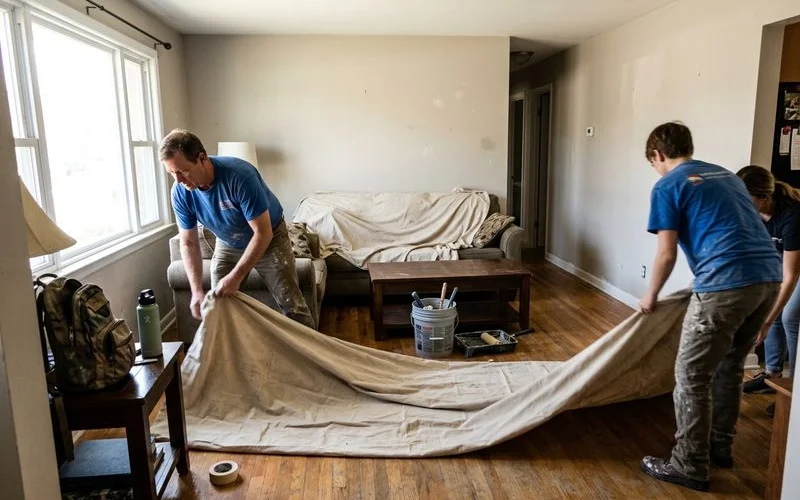
Heavy canvas drop cloths and rosin paper protect delicate flooring. Premium painter’s tape like 3M ScotchBlue or FrogTape produces crisp lines. For any home built before 1978, EPA Lead Renovation, Repair and Painting (RRP) rules require certified containment of toxic dust.
8. What Is the Schedule?
Clear scheduling expectations prevent major headaches once the project begins. Ask when the crew will start, how many working days the project requires, and what happens if weather forces a delay.
Most exterior paints require a minimum surface temperature of 50 degrees Fahrenheit for proper curing. Specialty acrylics like Benjamin Moore Element Guard cure as low as 35 degrees. A knowledgeable contractor monitors actual surface temperature, not just the local air forecast. Work pauses when conditions include:
- High humidity or incoming rain
- Surface temperatures below the product minimum
- Extreme direct sun that dries paint too rapidly
Comparing Bids Side by Side
Use this framework to line up competing proposals. A visual comparison reveals missing information instantly.
| Question | Bid A | Bid B | Bid C |
|---|---|---|---|
| Liability insurance amount | |||
| Workers’ comp certificate | |||
| In-house W-2 crew? | |||
| PCA prep steps listed | |||
| Specific products and coats | |||
| Fixed price contract? | |||
| Workmanship warranty length | |||
| Schedule and weather policy |
Red Flags During the Estimate
The Better Business Bureau frequently lists home improvement scams among its most reported consumer issues. Stay alert for these warning signs:
- Cash-only demands or refusal to provide a written quote
- High-pressure tactics to force a same-day signature
- Deposit requests exceeding 33 percent before work is scheduled
- Inability to produce a current certificate of insurance
- Vague answers about surface prep or product selection
- A price that falls drastically below every other local bid
A dramatically low price usually signals skipped preparation, no insurance, or inferior materials.
Questions About Products and Colors
A knowledgeable painter explains why a specific product suits a high-traffic hallway or a sun-baked exterior wall. Ask about:
- Which product line and why? The answer should name specific brands matched to your conditions.
- Is color consultation included? Professional guidance with samples and HOA palettes saves significant time.
- Do you offer low-VOC or zero-VOC? Products with GREENGUARD Gold certification matter for nurseries, allergy sufferers, and occupied offices.
- What sheen for each surface? Walls often look best in eggshell while trim requires more durable satin or semi-gloss.
Questions About Communication
Clear communication prevents the majority of contractor disputes. Establish the information flow before signing:
- How will you notify me if weather or other issues change the schedule?
- Who answers the phone if I have a question mid-project?
- How do you handle change requests once work starts?
- Is there a formal walkthrough at the end?
Our Answers, Up Front
Every quote from Limestone & Lacquer lists exact PCA prep steps, number of coats, and specific products. We send complete insurance documentation upon request and state our 3-year workmanship warranty on every contract. When you are ready to compare, get a fixed written quote from our Georgetown team and hold our proposal against this checklist.